VETERINARY WORLD
ARCHIVE
VOLUME 19 | ISSUE 1
Previous
Next
Research Article
| 06 Jan 2026 | 1–14
1. Cross-domain antimicrobial resistance in poultry farming: A One Health assessment of antimicrobial use and multidrug resistance in Kiambu County, Kenya
Munene
et al.
Research Article
| 06 Jan 2026 | 15–28
2. First validated liquid chromatography–tandem mass spectrometry method for simultaneous quantification of propranolol and 4-hydroxypropranolol in pig plasma and dried blood spots and its application to a pharmacokinetic study
Bardhi
et al.
Research Article
| 06 Jan 2026 | 29–38
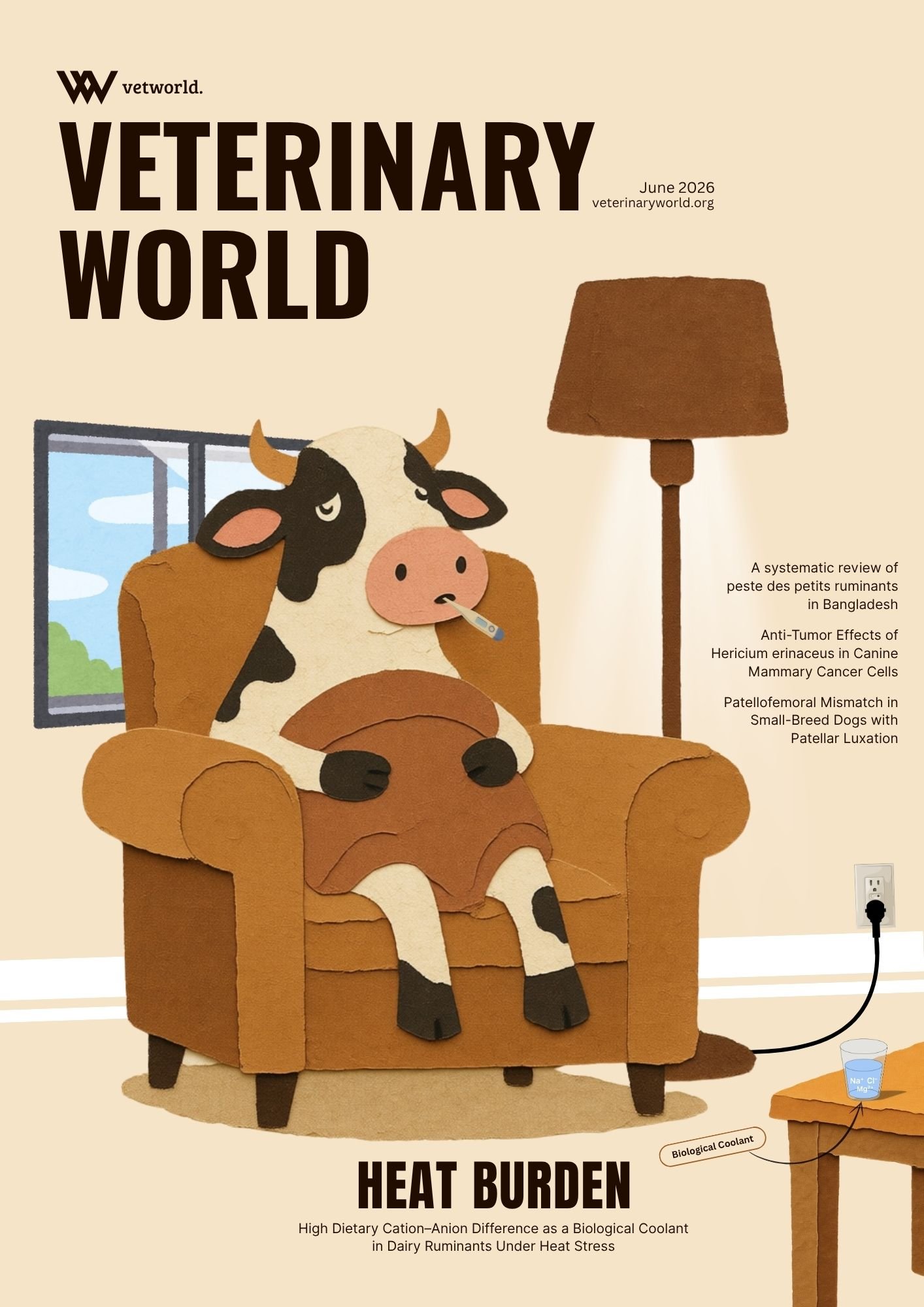
3. Age-dependent endocrine and cellular adaptations to Mediterranean summer heat stress in lactating Saanen goats
Atli
More from this issue
Research Article
| 06 Jan 2026 | 39–51
4. Black soldier fly protein–based microencapsulation of lemongrass oil improves rumen fermentation efficiency and mitigates methane production in vitro
Matra
et al.
Research Article
| 08 Jan 2026 | 52–64
5. Antimicrobial resistance, extended-spectrum β-lactamase determinants, and virulence gene profiles of Escherichia coli along the pork production chain in central Thailand
Prapasawat
et al.
Research Article
| 08 Jan 2026 | 65–80
6. Trimodal cytological integration of micronuclei assay, argyrophilic nucleolar organizer region staining, and cytomorphometry enhances diagnostic discrimination of canine gingival masses
Hoonpo
et al.
Research Article
| 08 Jan 2026 | 81–96
7. Whole-genome characterization and zoonotic insights of feline rotavirus A genotypes G3P[9] and novel G6P[9] circulating in domestic cats in Thailand
Thaw
et al.
Research Article
| 08 Jan 2026 | 97–110
8. Knowledge, attitudes, and practices toward avian influenza among free-grazing duck farmers in Central Thailand: An analytical cross-sectional study
Boonyapisitsopa
et al.
Research Article
| 14 Jan 2026 | 111–124
9. Maternal antioxidant supplementation enhances oxidative balance, milk bioactivity, and neonatal performance in Beetal goats during the transition period
Zaib
et al.
Research Article
| 14 Jan 2026 | 125–134
10. Long-term biochemical stability of fresh-frozen plasma from Asian elephants (Elephas maximus) stored at −20°C: Implications for emergency transfusion protocols for elephant endotheliotropic herpesvirus hemorrhagic disease
Thitaram
et al.
Research Article
| 14 Jan 2026 | 135–148
11. Proteomic signatures of cervical mucus associated with fertility in Bali heifers (Bos javanicus): Implications for biomarker-based selection in artificial insemination programs
Yusuf
et al.
Research Article
| 14 Jan 2026 | 149–164
12. Dose-dependent effects of dietary quercetin on performance, egg quality, metabolic health, and antioxidant defense in laying hens: A systematic review and meta-analysis
Hartanto
et al.
Reviewer Acknowledgments
| 14 Jan 2026 | 165–168
13. Veterinary World reviewer acknowledgment 2025
Sherasiya
Research Article
| 14 Jan 2026 | 169–179
14. Field evaluation of visual endoscope-assisted transcervical artificial insemination in goats: Effects on insemination time and pregnancy outcomes under tropical conditions
Sringam
et al.
Research Article
| 20 Jan 2026 | 180–190
15. Differential induction of host cell autophagy by virulent and precocious strains of Eimeria tenella in vitro and in vivo
Zhang
et al.
Research Article
| 20 Jan 2026 | 191–209
16. Infestation patterns and ecological distribution of fleas and sucking lice on Rattus tanezumi in southwest China: Evidence from a long-term multi-provincial study (2000–2024)
Zhu
et al.
Research Article
| 20 Jan 2026 | 210–223
17. District-level joint risk assessment of highly pathogenic avian influenza H5N1 at the human–animal–environment interface in live bird markets of Bogor, Indonesia
Sudarnika
et al.
Review Article
| 20 Jan 2026 | 224–263
18. Alginate oligosaccharides derived from tropical brown seaweeds as sustainable alternatives to antibiotic growth promoters in poultry nutrition: Functional mechanisms and production perspectives
Reski
et al.
Research Article
| 25 Jan 2026 | 264–281
19. Dose-dependent effects of dietary quercetin on cecal microbiota, hematological responses, and production efficiency in Arbor Acres broiler chickens
Rakhmatullin
et al.
Research Article
| 25 Jan 2026 | 282–294
20. Growth performance and muscle histological characteristics of IPB-D3 chickens reared under intensive and free-range systems
Prawira
et al.
Research Article
| 25 Jan 2026 | 295–309
21. Conjunctival transforming growth factor-β2 and vascular endothelial growth factor in canine keratoconjunctivitis sicca: Baseline alterations, clinical associations, and response to 0.2% cyclosporine therapy
Rodrigues
et al.
Research Article
| 25 Jan 2026 | 310–323
22. Fifteen-day topical ketorolac tromethamine, with and without benzalkonium chloride, alters tear function, goblet cell density, and meibomian gland integrity in healthy cats
Silveira
et al.
Research Article
| 25 Jan 2026 | 324–338
23. Occurrence, molecular confirmation, and multidrug resistance of methicillin-resistant Staphylococcus aureus and Staphylococcus pseudintermedius in companion animals in Indonesia
Alhadz
et al.
Research Article
| 25 Jan 2026 | 339–354
24. Dietary Scutellaria baicalensis polysaccharide as an antibiotic alternative improves growth performance, antioxidant capacity, and intestinal mucosal immunity in broiler chickens
Liu
et al.
Research Article
| 30 Jan 2026 | 355–365
25. Dietary 5-aminolevulinic acid modulates gut microbiota, reduces oxidative stress, and enhances immune status in weanling piglets: An 8-week exploratory study
Ishikawa
et al.
Research Article
| 30 Jan 2026 | 366–379
26. Fecal carriage, transferable β-lactam resistance, and efflux pump contribution in third-generation cephalosporin-resistant Escherichia coli from small-scale farm animals and workers in northern Thailand
Tansawai
Research Article
| 30 Jan 2026 | 380–388
27. HACCP-compatible ear acupuncture using biodegradable starch-based needles mitigates transport-induced physiological and oxidative stress in calves
Sato
et al.
Research Article
| 31 Jan 2026 | 389–408
28. Operationalizing the One Health approach in a conflict-affected setting: A scientometric review of policy foundations, systemic gaps, and future pathways in Ukraine
Gerilovych
et al.
Research Article
| 31 Jan 2026 | 409–421
29. Toxin genotypes and antimicrobial resistance profiles of Clostridium perfringens isolated from healthy and diseased goats in Jiangsu Province, China
Huang
et al.
Research Article
| 31 Jan 2026 | 422–439
30. Comparative lobe-specific histomorphometric evaluation of pulmonary architecture, fibrosis, and alveolar macrophage distribution in swine raised under different management systems
Chaiyawong
et al.
Research Article
| 31 Jan 2026 | 440–447
31. Effect of direct-fed microbial feed blocks on blood β-hydroxybutyrate and milk yield in early postpartum buffaloes under field conditions
Murty
et al.
Research Article
| 31 Jan 2026 | 448–468
32. Immunoinformatics-driven design of a conserved RNA-dependent RNA polymerase-based multi-epitope vaccine against avian infectious bronchitis virus
Rezaei
et al.
RECENT ISSUES
Volume 19
Issue 10
Volume 19
Issue 9
Volume 19
Issue 8
Volume 19
Issue 7
Volume 19
Issue 6
VIEW ARCHIVE →